
Agent Based Microeconomics
About Course
Agent Based Microeconomics
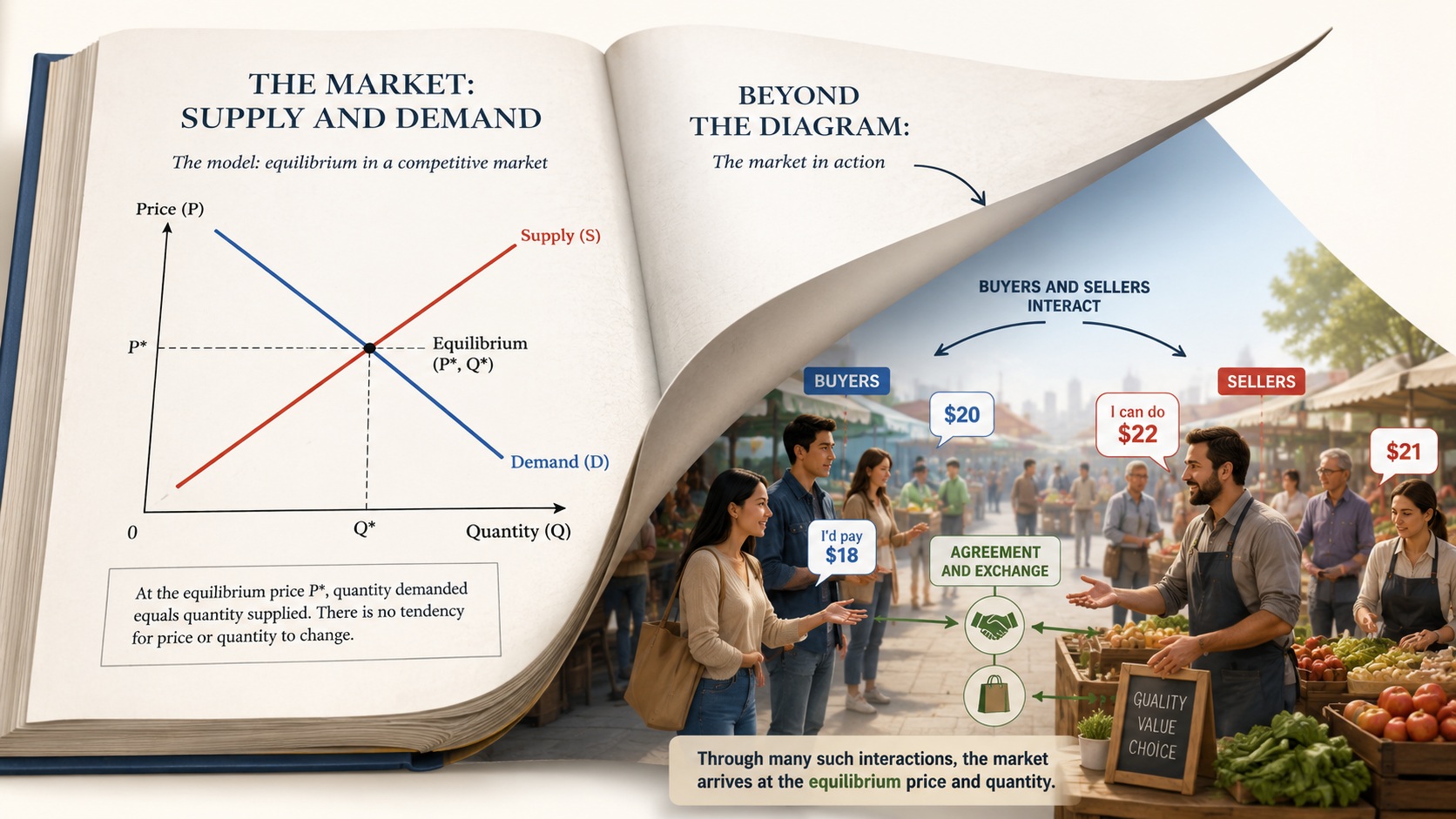
Most students learn microeconomics through diagrams and equations. Supply slopes upward, demand slopes downward, the two curves cross, and equilibrium is reached. The picture is elegant and simple — but it hides nearly everything that makes real markets interesting.
Who are the buyers and sellers? What do they know? How do they meet? How are prices formed? Can trade take place before equilibrium? What happens when information is limited, search is costly, contracts are binding, or people revise their plans?
This course introduces a new way of learning microeconomics: Agent Based Microeconomics.
Instead of beginning with curves, equations, and equilibrium conditions, we begin with agents: buyers, sellers, firms, workers, landlords, tenants, consumers, producers, and institutions. We describe what they know, what they want, how they behave, how they interact, and what rules govern their exchange. Then we study what happens.
This is, in many ways, the natural way to do economics. Real economies are made up of people making decisions under limited information, uncertainty, social pressure, institutional rules, moral commitments, and changing circumstances. Traditional mathematical economics often forced these realities into a narrow framework because the equations had to be solved by hand. The mathematics became a straitjacket. To make the model tractable, economists had to assume away many of the features that matter most: imperfect information, search, bargaining, learning, mistakes, trust, contracts, time, institutions, and adaptation.
Agent-based modeling releases us from this straitjacket.
The task of the economist becomes clearer and more natural: describe the economic world as accurately and transparently as possible. Specify the agents, their rules of behavior, their information, their opportunities, their constraints, and their institutional setting. Then let the model unfold. In larger models, the computer can carry out the simulation. In this introductory course, we begin with models so simple that they can be understood by hand, with tables, and later with Excel. The purpose is not technical sophistication. The purpose is understanding.
We begin with the most famous model in economics: supply and demand. Textbooks show the final result — an equilibrium price and quantity — but they do not show the market process that could produce it. In this course, we rebuild supply and demand from the ground up. We start with individual buyers and sellers, give them simple rules, allow them to meet, bargain, trade, learn, and compete, and then examine whether the familiar textbook result emerges.
This approach makes hidden assumptions visible. Students see that textbook equilibrium does not appear automatically. It requires strong assumptions about information, competition, contracts, renegotiation, search costs, and institutional rules. Once those assumptions are changed, market outcomes may change dramatically.
The course is designed especially for students and teachers who want to understand economics more deeply. It avoids programming at the beginning and uses simple, transparent models that can be simulated step by step. Later, the same logic can be extended to Excel, larger simulations, classroom exercises, research projects, and thesis work.
By the end of the course, students will learn how to:
-
understand supply and demand as the outcome of agent interaction;
-
identify the hidden assumptions behind textbook diagrams;
-
build simple agent-based models of markets;
-
study how information, search, bargaining, contracts, and institutions shape outcomes;
-
compare conventional equilibrium models with process-based explanations;
-
use ABM as a powerful tool for teaching, research, and economic understanding.
This course is not merely a new technique for teaching old microeconomics. It is a different way of thinking about economic life. Instead of memorizing where curves cross, we ask how markets actually work. Instead of forcing reality into equations, we build models from agents, rules, information, and interaction.
The promise of Agent Based Microeconomics is simple:
From curves to agents.
From diagrams to market processes.
From mathematical assumptions to economic understanding.
Course Content
Introducing Agent Based Models
2nd Module: Agent-Based Models of Supply and Demand in the Rental Market
Student Ratings & Reviews
